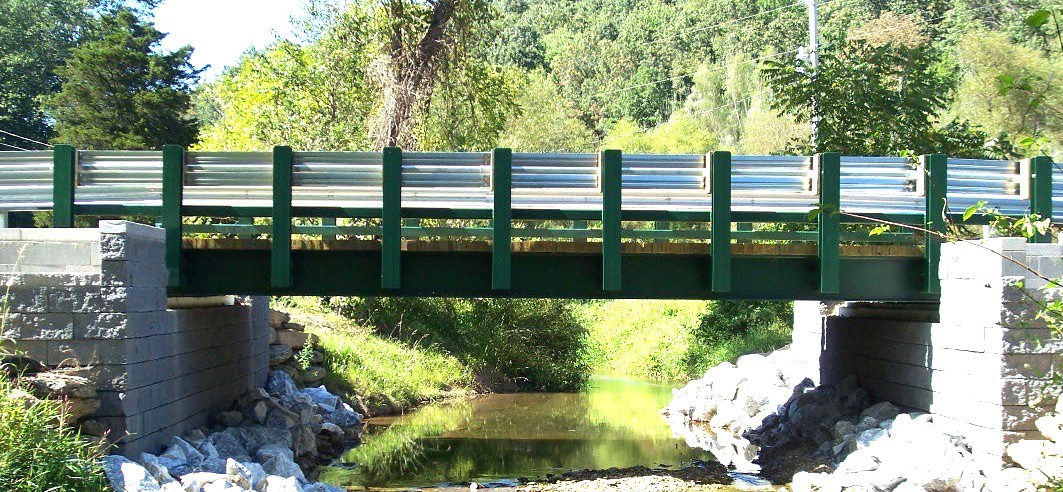
Permanent Access for Low-traffic Public and Private Roads
Mustang’s permanent bridge solutions are custom built to accommodate crossings of 15’ to 92’. Serving a wide range of industries, including energy, forestry, mining, landfill, agriculture and residential, our permanent vehicular bridges are engineered for a variety of applications.
They’re an ideal solution for low-traffic public roads, as well as private access routes.
- Customized to match your specific crossing and load requirements
- Quick to install and dismantle, causing minimal disruption to work zones
- Efficient to transport, reducing freight costs
- Prefabricated solutions simplify the construction process, reducing labor costs
- Engineered for continuous use on low-traffic roads and industrial access points
- Can be installed without disturbance to stream banks and do not require any support pillars inside the waterway
Discuss your specific application with our experienced sales engineers to determine the best option.
Mustang Extreme Permanent Bridges are custom-built in lengths from 15′ to 100′. Features include:
- Three-coat paint system
- Inclusion of a waterproofing membrane between the steel stringers and timber deck
- Treated nominal 6” thick timber decking
- Full-dimension vertical steel end plates [“backwalls”] to retain roadway aggregate and prevent infiltration between stringers
We also offer fast deploy, temporary prefabricated bridges that can be used for permanent installations.
Permanent Bridge Features
Bridge Lengths
While bridges can be fabricated to any length, beams are typically produced in 5’ increments.
Bridges up to 70’ in length can typically be transported as full-length units.
Due to transport logistics, bridges 75 to 100 feet long are typically fabricated as partial-length units that are then weld or bolt-spliced on-site to achieve the full length.
For bridges 70 feet and under, a 4-foot support is required under each side when placed on temporary bearing surfaces such as 12” crane mats or stone aggregate. Only 2-foot support is required under each side when placed on the concrete footer abutments commonly used in permanent installations.
For bridges over 70 feet, a 4-foot support under each side is required, installed on concrete abutment footers. The inverse T-footer is the most common abutment design, providing a stable base for long-term, multi-year applications.
Abutments are evaluated based on specific on-site ground and project conditions. Mustang’s team is highly experienced in coordinating with customers’ civil engineering teams to ensure the bridge design and abutment system are properly matched for each site and application.
Bridge Widths
The most common width it 14 feet, but our custom bridges can be fabricated to any width.
Bridges with a guardrail system are typically fabricated in even foot increments of nominal deck width [i.e. 12’, 14’, 16’, 18’, etc]. Actual clear/useable travel width typically varies +/- from the deck width by a few inches depending on the exact guardrail design.
Bridges with a timber curb system are typically fabricated in odd foot increments of nominal/useable deck width [i.e. 13’, 15’, 17’, etc].
Guardrail Options
Guardrail can be fabricated in a wide variety of guardrail systems: timber curb, square tube, “StrongPost” with W-rail and pedestrian style to meet OSHA or ASTO regulations.
Calculations showing strength equivalency to a given TL-rating can be provided at additional cost. TL1 through TL3 can be achieved fairly easily.
Please refer to the photos below for the various options.
End Plates
Permanent bridges are typically fabricated with full-height/width vertical steel plates at both ends to eliminate the need for a backwall on the foundations.
Finish Options
We offer a choice of brown or green paint. Custom colors may be requested for an additional charge. Our most common finish is a urethane topcoat applied over two coats of an epoxy primer, with surface preparation as required by the paint manufacturer.
Hot-Dipped Galvanized – Galvanizing typically provides the best lifespan with the least maintenance. Typical cost of a galvanized structure is 20% – 40% higher than a painted
A588 “Weathering” Steel – The suitability of weathering steel should be evaluated on a case-by- case basis as its performance and cost effectiveness can vary drastically from one project to the next
Typical Deck Systems
The typical deck system is a treated, nail-laminated nominal 6” thick timber board. Decking can be used standalone or overlaid with two different options:
- Longitudinal timber “running plank.” This is a second timber layer oriented perpendicular to the primary timber The running plank serves as a sacrificial wear surface and spreads the tire loads out over a larger number of deck boards.
- To extend the life of the bridge, a waterproofing membrane is installed over the timber deck, followed by a 2–3” asphalt wearing course. This layered system seals the deck, prevents water infiltration, and protects the entire structure from moisture damage.
Open metal bar grating is a more expensive option that provides terrific lifespan.
Recent Projects
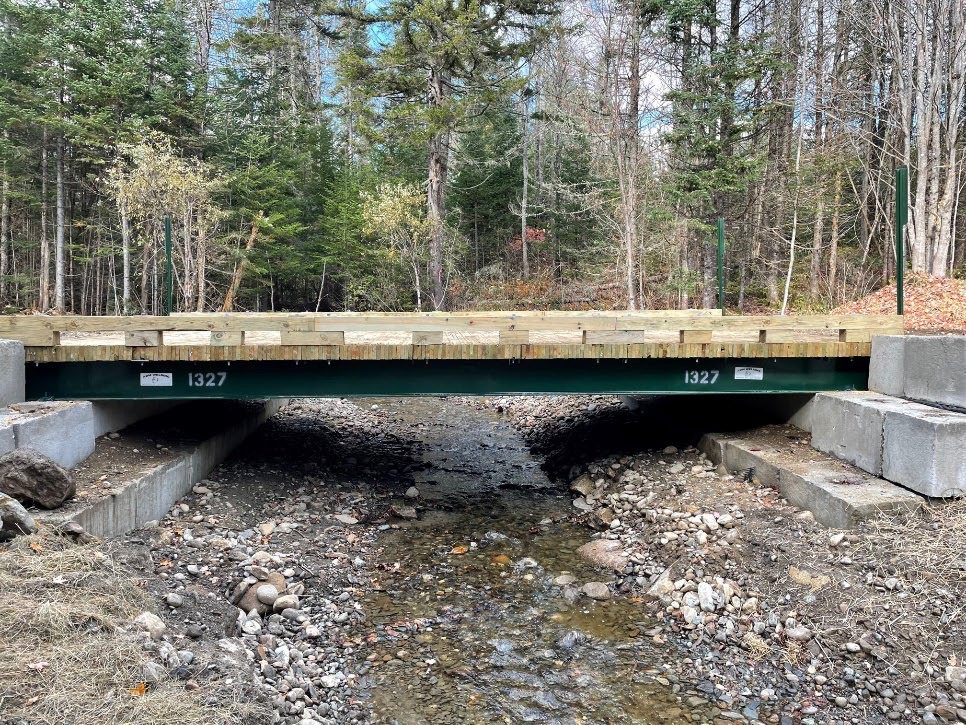
A 15’×30’ timber-curb bridge with a painted finish and precast concrete foundations built for a forest landowner.
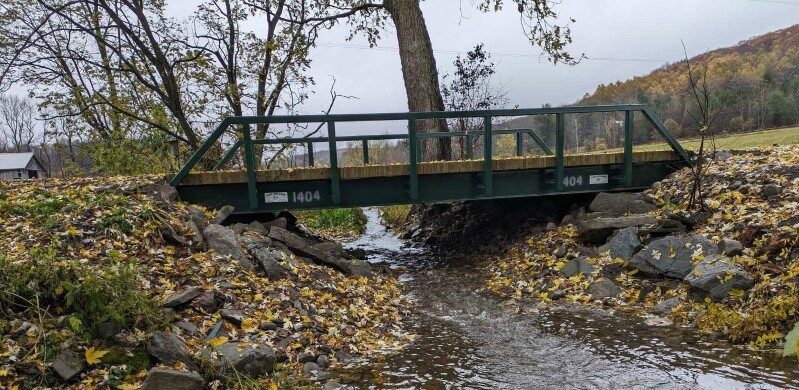
A 12’×25’ bridge with basic square-tube railing, a painted finish, and precast concrete foundations built for a private residence.
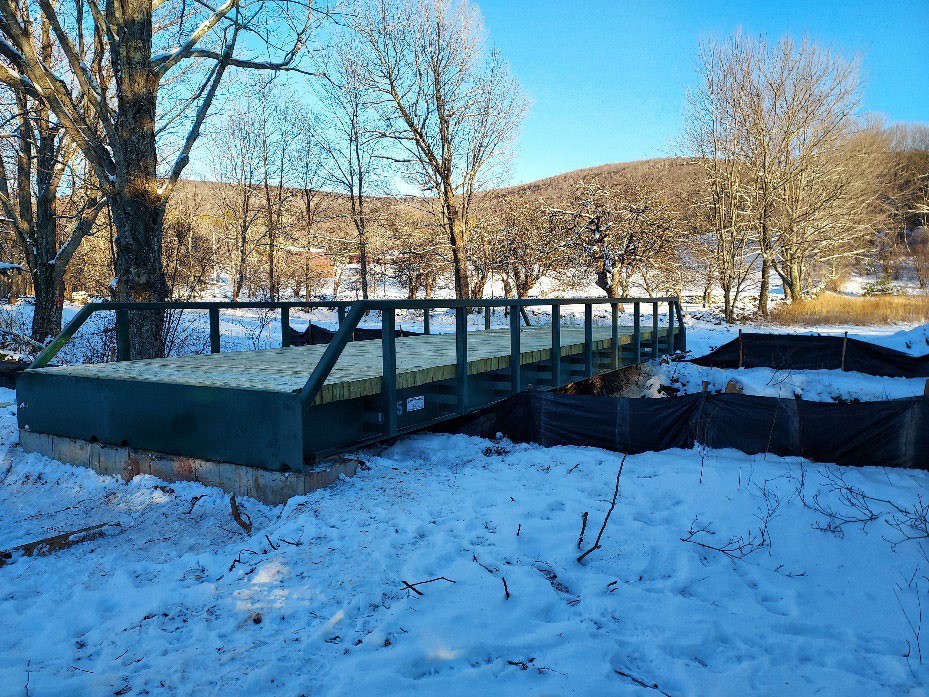
A 12’×40’ bridge with basic square-tube railing, a painted finish, and cast-in-place concrete strip footings built for a private residence.
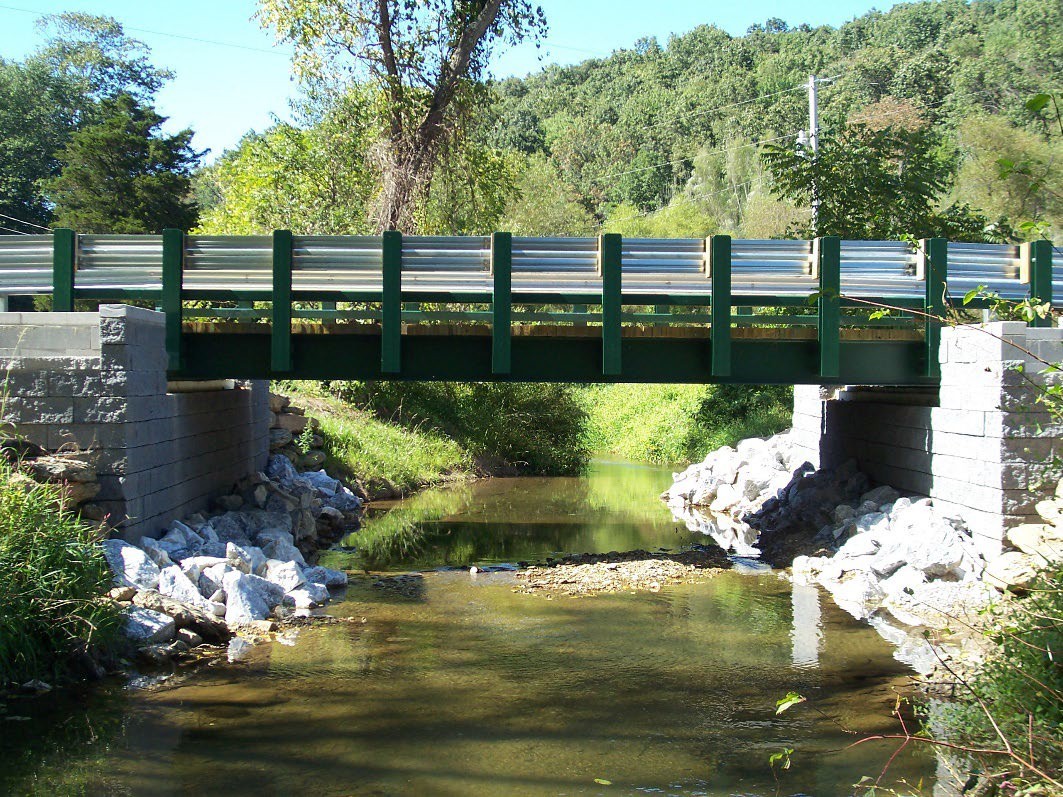
A 14’×35’ bridge with StrongPost W-rail railing, a painted finish, and GRS foundations built for a township.
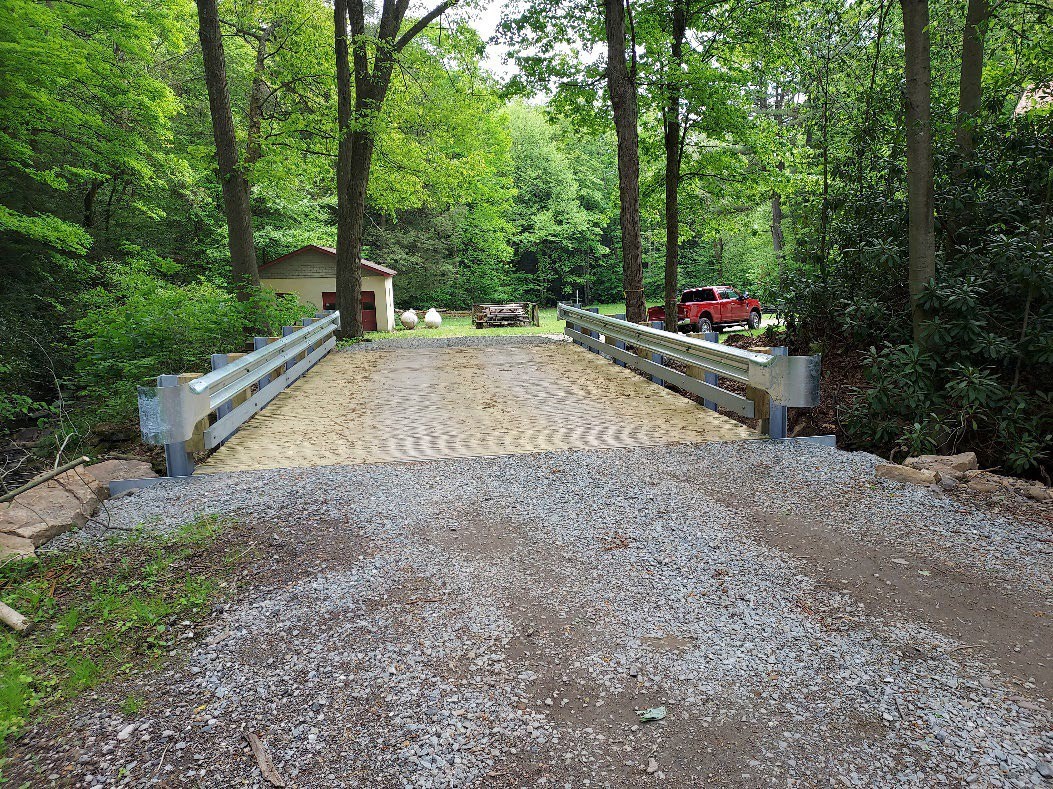
A 16’×30’ bridge with StrongPost W-rail railing, a galvanized finish, and cast-in-place strip footings placed behind existing abutments built for the Girl Scouts of Western PA.
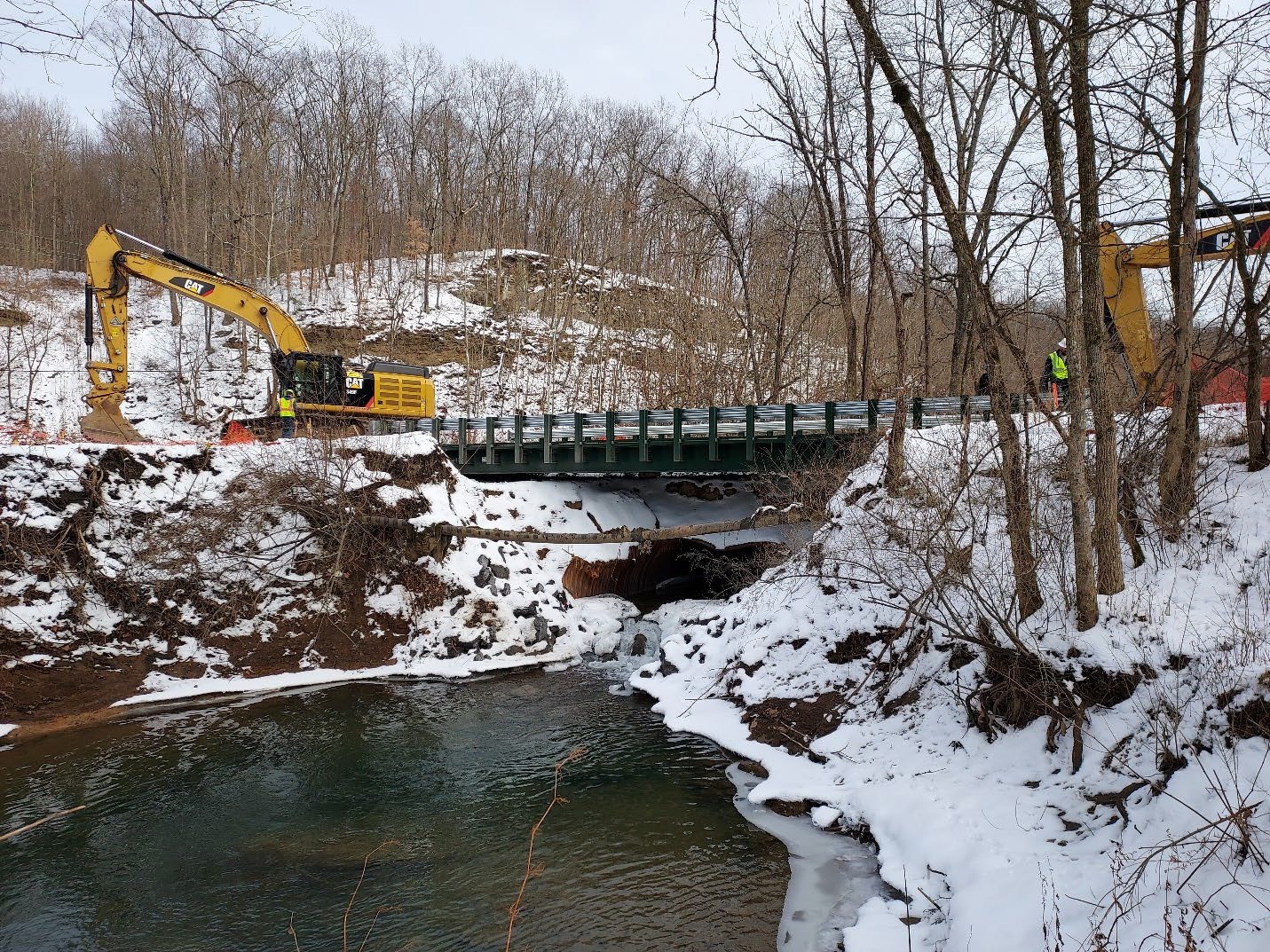
A 22’×60’ bridge with StrongPost W-rail railing, a painted finish, and caisson foundations with a concrete header beam built for an oil & gas company.